Quick Answer: There are 66 books in the Bible if you’re holding a Protestant Bible: 39 Old Testament and 27 New Testament. A Catholic Bible has 73, since it keeps seven extra Old Testament books known as the deuterocanonical books. Orthodox Bibles carry a few more than that, and the Ethiopian Orthodox Bible tops the list at 81. Almost every church, though, reads the same 27 New Testament books.
Table of Contents
How Many Books Are in the Bible? Every Major Count
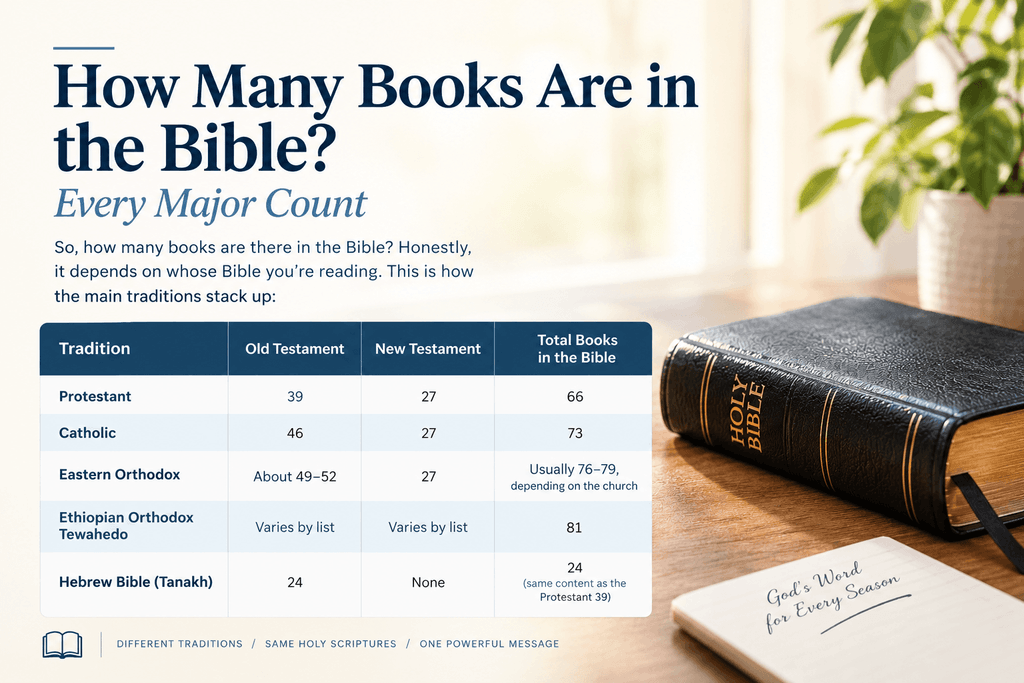
So, how many books are there in the Bible? Honestly, it depends on whose Bible you’re reading. This is how the main traditions stack up:
| Tradition | Old Testament | New Testament | Total Books in the Bible |
| Protestant | 39 | 27 | 66 |
| Catholic | 46 | 27 | 73 |
| Eastern Orthodox | About 49–52 | 27 | Usually 76–79, depending on the church |
| Ethiopian Orthodox Tewahedo | Varies by list | Varies by list | 81 |
| Hebrew Bible (Tanakh) | 24 | None | 24 (same content as the Protestant 39) |
There’s even an exception hiding inside the New Testament. The Assyrian Church of the East has long used a 22-book New Testament, drawn from the old Syriac Peshitta. It leaves out 2 Peter, 2 and 3 John, Jude, and Revelation. So the claim that every church agrees on the New Testament is true, but only mostly.
Books in the Bible by Testament: The 66-Book Bible
If you picked up a Bible at a bookstore here in Columbia, odds are it has 66 books. That makes it a natural place to start sorting the books in the Bible into groups.
The 39 Old Testament Books in Five Groups
Think of the Old Testament as a library with five shelves. It runs from creation through Israel’s long, messy history, and it closes roughly 400 years before Jesus was born.
The first shelf holds the Law, also called the Pentateuch: Genesis, Exodus, Leviticus, Numbers, and Deuteronomy. Next come 12 books of history, starting with Joshua, Judges, and Ruth. They continue through 1 and 2 Samuel, 1 and 2 Kings, 1 and 2 Chronicles, Ezra, Nehemiah, and Esther. The third shelf is poetry and wisdom, with Job, Psalms, Proverbs, Ecclesiastes, and Song of Solomon.
The prophets fill the last two shelves. The five “major” prophets are Isaiah, Jeremiah, Lamentations, Ezekiel, and Daniel. After them come twelve “minor” prophets: Hosea, Joel, Amos, Obadiah, Jonah, Micah, Nahum, Habakkuk, Zephaniah, Haggai, Zechariah, and Malachi.
Don’t let those labels fool you, by the way. “Major” and “minor” describe size, not importance. Isaiah stretches across 66 chapters, while you could read Obadiah standing in line at the grocery store.
The 27 New Testament Books in Five Groups
The New Testament is much shorter. Its authors wrote in Greek, and most scholars date the writing to roughly AD 50 through AD 100. It sorts neatly into five groups too.
It opens with four Gospels: Matthew, Mark, Luke, and John. Then comes one book of history, Acts. After that you’ll find Paul’s 13 letters, which are Romans, 1 and 2 Corinthians, Galatians, Ephesians, Philippians, Colossians, 1 and 2 Thessalonians, 1 and 2 Timothy, Titus, and Philemon.
Most people call the next eight books the general letters. Those are Hebrews, James, 1 and 2 Peter, 1, 2, and 3 John, and Jude. Finally, Revelation closes everything out as the Bible’s one book of prophecy.
Why the Hebrew Bible Counts 24 Books
Jewish readers use the Tanakh. Its name is actually an acronym built from its three parts: Torah (Law), Nevi’im (Prophets), and Ketuvim (Writings). It counts 24 books, and yet it holds the very same text as the 39 in a Protestant Old Testament.
So where do the “missing” 15 go? Nowhere, really. The Tanakh simply bundles books together. Samuel counts as one book instead of two, and so do Kings and Chronicles. Ezra and Nehemiah share a single book, while all twelve minor prophets live on one scroll called “The Twelve.”
Back in the first century, the historian Josephus counted the books in the Bible as 22 (Against Apion 1.8). He most likely did that by joining Ruth to Judges and Lamentations to Jeremiah.
The ending is different as well. Christian Old Testaments finish with Malachi, but the Tanakh ends with Chronicles.
How Many Books Are in the Catholic Bible?
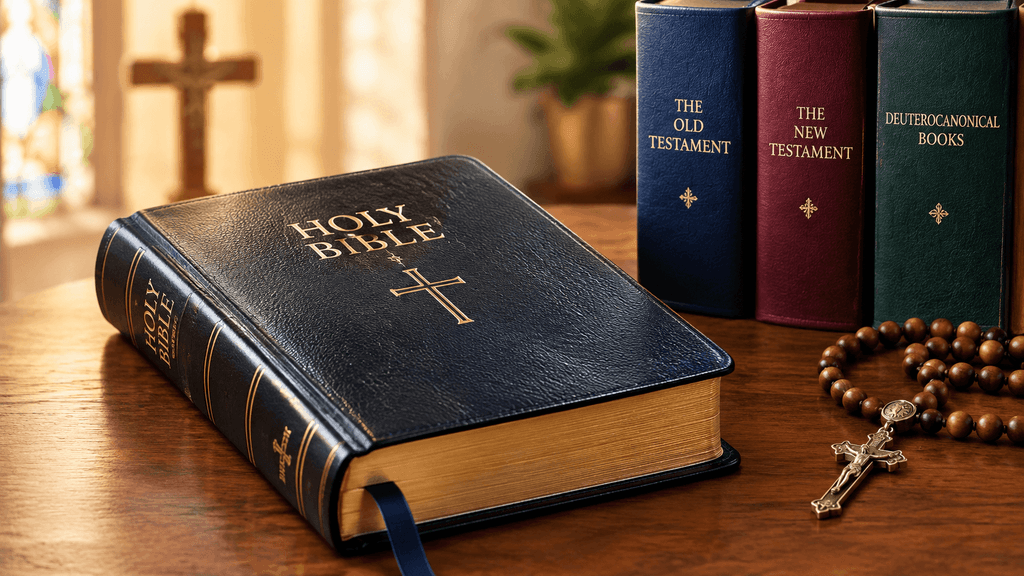
If your question is how many books are in the Catholic Bible, the answer is 73. That’s 46 in the Old Testament plus the usual 27 in the New, which works out to seven more books in the Bible than a Protestant edition holds. The Council of Trent confirmed this list in 1546, during its fourth session, partly in response to the Protestant Reformation.
The 7 Deuterocanonical Books and the Extra Chapters
Seven books make up the difference: Tobit, Judith, 1 Maccabees, 2 Maccabees, Wisdom (or the Wisdom of Solomon), Sirach (sometimes called Ecclesiasticus), and Baruch.
Two familiar books also run a little longer in a Catholic Bible. Esther includes added passages, among them prayers from Mordecai and Esther. Daniel picks up the Prayer of Azariah and the Song of the Three Young Men, along with the stories of Susanna and of Bel and the Dragon. So when people search how many books are in the Bible Catholic readers use, those extra chapters belong in the answer too.
Where did all this material come from? Mostly from the Septuagint, a Greek translation of the Hebrew Scriptures made in Egypt during the third and second centuries BC. Greek-speaking Christians read it everywhere, which explains why these books never left Catholic and Orthodox Bibles.
Apocrypha vs. Deuterocanonical: Same Books, Different Labels
Catholics call these the “deuterocanonical” books, a term meaning “second canon.” Protestants tend to say “Apocrypha,” which means “hidden.” It’s the same set of books, just with a different label and a different level of authority.
The reformers didn’t toss them in the trash, though. Martin Luther’s 1534 German Bible tucked them into their own section between the testaments. He described them as good to read but not equal to Scripture. The original 1611 King James Version printed 14 apocryphal books as well.
Gradually, Protestant publishers stopped including them. Meanwhile, the Westminster Confession of Faith (1647) spelled out the 66 books in the Bible that most Protestant churches still use.
How Many Books Are in the Orthodox and Ethiopian Bibles?
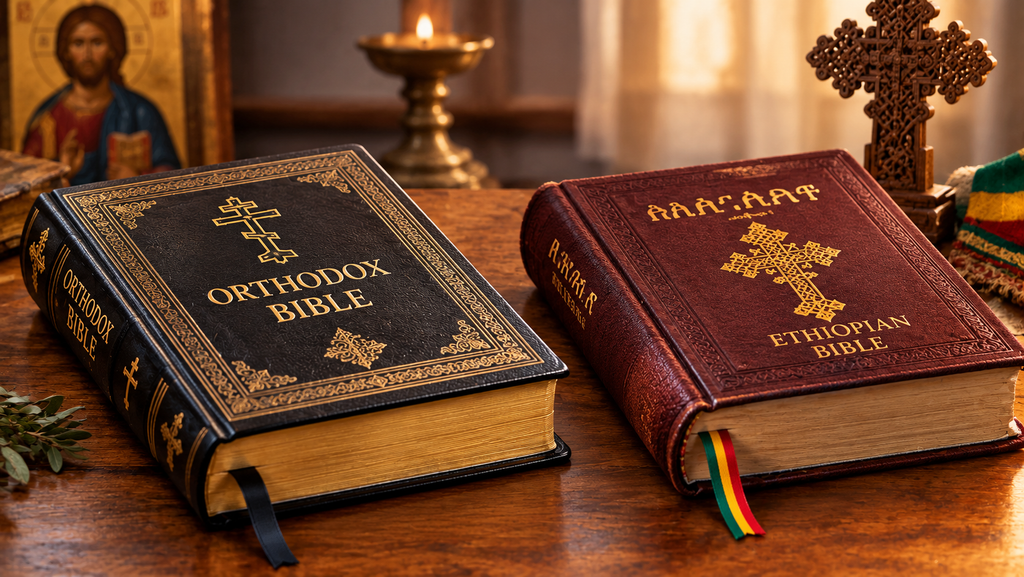
Eastern Orthodox churches keep the Catholic deuterocanonical books, and then they add a few of their own. You’ll usually find 1 Esdras, 3 Maccabees, the Prayer of Manasseh, and Psalm 151. Greek Bibles also often tuck 4 Maccabees into an appendix. Since the Orthodox world never held one council to pin down a single list, totals land anywhere from about 76 to 79.
The Ethiopian Bible: 81 Books, Including Enoch
No Christian tradition holds more books in the Bible than the Ethiopian Orthodox Tewahedo Church, whose count is traditionally 81. Its Old Testament includes 1 Enoch and Jubilees, plus three books called 1, 2, and 3 Meqabyan. (Don’t mix those up with Maccabees. Despite the similar name, they’re different books.) Some Ethiopian lists also add 4 Baruch, and the broader New Testament brings in church-order writings like the Sinodos and the Book of the Covenant.
That’s why anyone asking how many books are in the Ethiopian Bible usually hears 81. Still, the exact list shifts a bit, depending on whether you follow the narrower or the broader canon.
Here’s something many readers never notice: Enoch already shows up in their own Bible, in a way. Jude 14-15 quotes a prophecy straight from 1 Enoch. Even so, most churches don’t treat 1 Enoch itself as Scripture.
Who Decided Which Books Belong in the Bible?
Nobody sat in a room and voted the Bible into existence. Instead, over many years, churches recognized which writings carried the apostles’ authority and which ones they already read aloud in worship. The councils that met later mostly confirmed what believers had used for generations. That’s the honest short version of how the church settled the books in the Bible.
How the Old Testament Took Shape
Jesus himself pointed to “the law of Moses, and in the prophets, and in the psalms” (Luke 24:44, KJV). That lines up with the three parts of the Hebrew Scriptures.
You may have heard that a “Council of Jamnia” closed the Hebrew canon around AD 90. Most scholars now doubt that any formal council like that ever met. More likely, Jewish teachers settled on the 24-book collection gradually.
How the 27 New Testament Books Were Recognized
Around AD 140, a teacher named Marcion put out his own short Bible. It had an edited Gospel of Luke and ten of Paul’s letters, and it threw out the Old Testament entirely. That pushed church leaders to say plainly which books they trusted.
Some books took a while to win acceptance. In his Church History (3.25), Eusebius listed James, Jude, 2 Peter, and 2 and 3 John as “disputed,” and he noted mixed opinions about Revelation. Hebrews raised eyebrows in some regions too. Churches also respected and read other early writings, such as the Didache and 1 Clement, yet they never placed those on the same level as Scripture.
The turning point came in AD 367. That year, Bishop Athanasius of Alexandria wrote his 39th Festal Letter and listed exactly the 27 New Testament books we read today. A few decades later, the councils of Hippo (393) and Carthage (397) affirmed the same list.
| Knowing the Books Is a Start. Living Them Out Is Harder.You can memorize all 66 books in the Bible and still not know which passage speaks to your marriage, your grief, or the worry that keeps you up at night. That’s where biblical counseling helps. We open God’s Word with you and apply it to what you’re actually facing, online or in person in Columbia, SC.Request a Counseling Session |
What About the “Lost Books” of the Bible?
Search online for “lost books of the Bible,” and you’ll find plenty of dramatic headlines. Truthfully, most of those writings were never lost, and many weren’t banned either. Most churches simply didn’t accept them as Scripture.
They usually fall into one of three groups. First, there are the deuterocanonical books like Tobit, Judith, and Sirach, which Catholics and Orthodox accept but Protestants don’t. Second, some books belong to only one church’s Bible, such as 1 Enoch and Jubilees in the Ethiopian canon. Third, there are later writings like the Gospel of Thomas and the Gospel of Judas. Most scholars date those after the four Gospels, and no major church accepts them.
So the idea of secret books in the Bible that “the church removed” doesn’t really hold up. The real history is quieter. Churches weighed which books carried authority, and they settled most of those questions early.
Quick Facts: Chapters, Verses, and the Longest and Shortest Books
A few numbers about the books in the Bible, for the curious. All of these come from the 66-book Protestant Bible:
- Chapters: 1,189 in all, with 929 in the Old Testament and 260 in the New.
- Verses: 31,102 in the King James Version.
- Most chapters: Psalms, with 150.
- Longest and shortest chapters: Psalm 119 is the longest at 176 verses. Psalm 117, right before it, is the shortest, with just 2 verses.
- Shortest books: 2 John has 13 verses and 3 John has 14. In the Old Testament, Obadiah has 21.
- Authors: traditional estimates credit about 40 human writers over roughly 1,500 years.
Here’s one more detail the original writers never saw: chapter and verse numbers. An English archbishop named Stephen Langton added most of the chapter divisions in the early 1200s. Then, in 1551, a printer named Robert Estienne numbered the New Testament verses.
Where to Start Reading, Especially in a Hard Season
With 66 books in the Bible, page one isn’t always the best place to begin. Plenty of well-meaning readers start in Genesis and stall out somewhere in Leviticus. So it usually helps to start with books that feel close to everyday life.
John’s Gospel gives you a clear picture of who Jesus is. Proverbs hands out short, practical wisdom you can actually use on a Tuesday afternoon. James reads like a field guide for everyday faith. And Psalms has words for nearly every feeling you’ll ever have, joy and despair included.
Some books also meet you right in the middle of a hard season:
- Grief and loss: Ruth, Lamentations, and Psalm 34:18, “The LORD is nigh unto them that are of a broken heart”
- Anxiety and worry: Philippians 4:6-7 and Matthew 6:25-34
- Suffering you can’t explain: Job
- Marriage and family: Ephesians 4–5 and 1 Corinthians 13
If you’re walking through a loss and want someone to read these passages with you, our biblical grief counseling brings Scripture and prayer into that season. It rests on what Psalm 119:105 promises: that God’s Word is “a lamp unto my feet, and a light unto my path.” You can also learn more about our founder, Dr. Regina Maholmes, who holds a PhD in Biblical Counseling.
Frequently Asked Questions
How many books are in the King James Bible?
A King James Bible today has 66 books, with 39 in the Old Testament and 27 in the New. The original 1611 edition was bigger, though. It printed 14 apocryphal books between the testaments, which brought that edition to 80. Most publishers dropped those extra books during the 1800s.
What are the first and last books of the Bible?
Every Christian Bible starts with Genesis and ends with Revelation. Where the Old Testament stops depends on the tradition, however. Protestant Bibles close it with Malachi, while the Hebrew Bible ends with 2 Chronicles. Catholic Old Testaments usually finish with Malachi or 2 Maccabees, depending on the edition.
How many books of the Bible did Paul write?
Paul wrote 13 New Testament letters, from Romans through Philemon, more than any other New Testament writer. People once credited Hebrews to Paul as well. But the letter never names its author, so most scholars and many church traditions now treat Hebrews as anonymous.
How many people wrote the books in the Bible?
Traditional estimates say about 40 human authors wrote the Bible over roughly 1,500 years. Among them were kings, shepherds, prophets, fishermen, a doctor, and a tax collector. Christians believe God guided every one of them, because 2 Timothy 3:16 says, “All Scripture is given by inspiration of God.”
Can new books ever be added to the Bible?
No major Christian tradition expects to add new books. Catholics consider their list settled since the Council of Trent, and most Protestant churches follow the Westminster Confession’s 66 books. So even if an ancient manuscript turned up tomorrow, churches would treat it as a historical find, not new Scripture.